On my first soldering attempt, I turned six joints into six oddly shaped blobs of solder.
The whole process, from preparation to stopping, took only about 20 minutes. I had thought that after watching online tutorials, I could at least follow along. But once I actually held the soldering station handle, I realized: my eyes understood, but my hands didn’t.
A microphone without pins brought the project to a halt
I’m building an ESP32-S3 voice conversation robot. When I was about to connect the INMP441 omnidirectional microphone module, I discovered that the version I bought didn’t have the header pins soldered on.
Without header pins, the module can’t reliably connect to Dupont wires. So the voice function is stuck here for now.
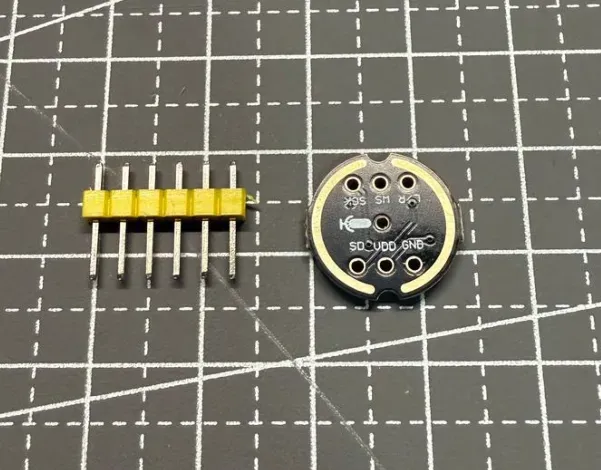
Before soldering, the round INMP441 module and a strip of six straight header pins are placed separately on the cutting mat; the module’s six solder holes don’t yet have pins installed.
To keep going, I bought my first T12 soldering station, along with a K-type knife tip, solder wire, 704 adhesive, and a practice board.
But when I actually started, I didn’t test-solder on the practice board first. Instead, I went straight to the INMP441. In other words, this microphone module was my very first soldering job.
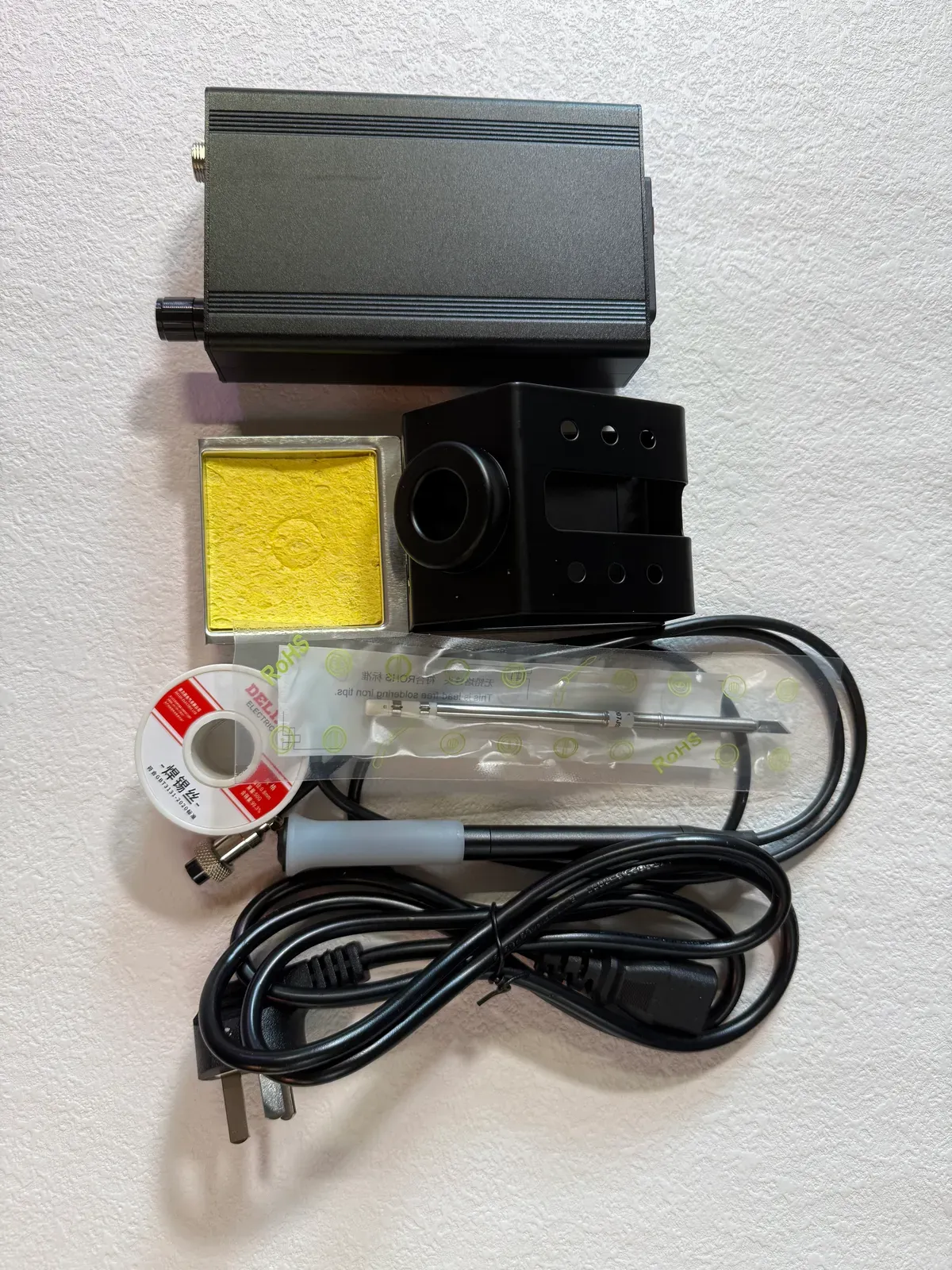
The soldering station kit prepared before my first soldering attempt: the station main unit, handle, stand, cleaning sponge, knife tip, and solder wire are visible.
The steps in the tutorial were clear, but when it was my turn, I was all thumbs
Before starting, I watched soldering tutorials online. My steps sounded simple enough:
-
First, use 704 adhesive to fix the header pins on both sides of the INMP441.
-
Set the soldering station to 250°C and tin the K-type knife tip for protection.
-
Then raise the temperature to 350°C and start soldering the six pins.
But once I actually started, I quickly got confused.
I didn’t know how to make the blade tip contact both the pin and the pad effectively at the same time. Sometimes the solder wouldn’t stick; other times it piled up into a blob the moment I fed it in. The clean, crisp motion in the online video looked completely different in my hands.
At the time I was using 0.3mm solder wire. It felt like it melted too fast, and I couldn’t quite control it. Later, following a recommendation from other users online, I ordered a roll of 0.8mm ‘White Monkey’ solder wire, planning to try it once it arrived.
But for now I can’t be sure whether the solder wire thickness was the main reason for this failed attempt. The new solder wire hasn’t arrived yet, and I haven’t done any comparative testing.
After 20 minutes, this is what I got
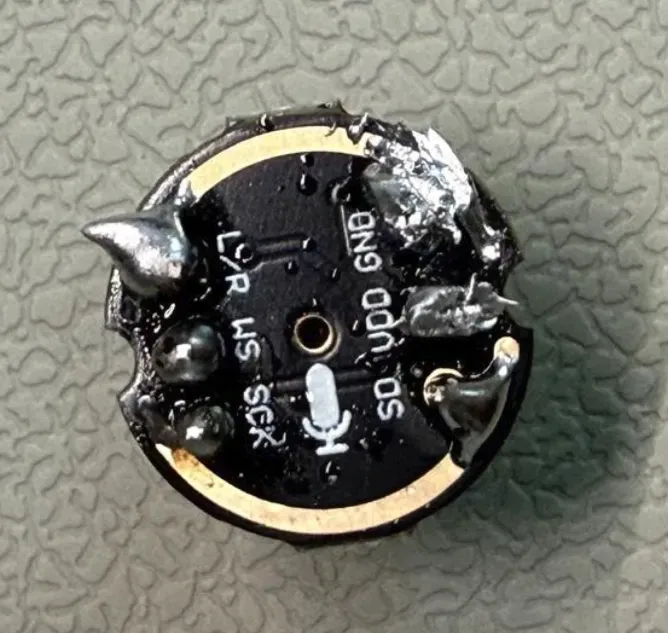
The labeled side of the INMP441 after the first soldering attempt: the shape and volume of the six solder joints are inconsistent, with some showing larger pointy or lumpy buildups.
If a full score is 10, how would you rate this soldering job?
This photo only shows one side of the module. The other side of the header pins, the back of the pads, whether adjacent solder joints are bridged, and whether the module works at all—none of that has been checked yet.
So a more accurate statement is not ‘I’ve soldered the header pins successfully,’ but rather ‘I’ve completed my first soldering attempt.’ This INMP441 hasn’t been connected to the ESP32 for a power-on test yet.
Eyes can learn, but hands don’t follow automatically
Watching others solder looks simple. I understood the steps and thought I had learned it. When I actually started practicing, I realized I still couldn’t do it.
That was my most direct feeling when I saw the soldering result.
I used to easily mistake ‘understanding’ for ‘being able to do it.’ I could understand the steps in the video, and I could recite the temperature and the order of operations, but these bits of knowledge didn’t automatically translate into manual skill.
Only when I actually pick up the tools do I encounter the problems that aren’t in the tutorial but must be faced in person: how to position your hands, how to make the blade tip touch properly, when to feed the solder, and how to stop and check after making a mistake.
These things cannot be acquired by just watching. I still need to practice more and learn through practice.
AI can teach me knowledge, but it can’t replace my hands-on practice
I don’t think this is something ‘AI can’t teach.’ AI can tell me what tools I need, explain the soldering steps, and help me organize troubleshooting directions when problems arise.
But AI can’t hold the soldering iron for me, and it can’t give me the feel of the tool. What really changed my ability was my own 20 minutes of hands-on practice.
So now I prefer to see AI as a teacher I can ask anytime, not as a pair of hands that can do the practice for me. It can help me understand knowledge faster, but after understanding, I still have to try it myself.
The first failure is also a real beginning
There’s no new progress on the voice conversation feature today. Whether the microphone works is still unconfirmed, and the new solder wire hasn’t been tested yet.
But these 20 minutes weren’t wasted.
At least starting from today, I’m no longer just someone who has watched soldering tutorials. I’m someone who actually picked up the tool, left behind a set of odd solder joints, and is ready to keep practicing.
That’s how many things work: seeing with your eyes is just the beginning of understanding; truly doing it with your hands is when learning actually begins.